
Ranked choice voting (RCV) is an election method in which voters rank candidates for an office in order of their preference, first choice, second choice, third choice, and so on. RCV gives voters more power, creates better voter experience, better campaigns, and ultimately, better government.
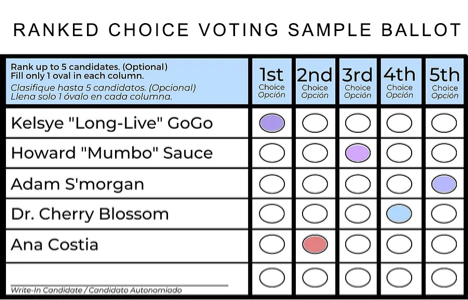
If a candidate receives more than half of the first choices, that candidate wins, just like in any other election. However, if there is no majority winner after counting the first choices, the race is decided by an instant runoff. The candidate with the fewest votes is eliminated, and voters who ranked that candidate as their first choice will have their votes reallocated for their next choice. This process continues until a majority winner, a candidate with more than half of the vote, wins.
Why choose Ranked Choice Voting?
Winners have majority support
Each vote should count to the full extent possible: with RCV, a voter’s choices count, even if their first choice loses the election. RCV yields election outcomes that better represent voter preferences. Winners elected with RCV have majority support and more truly represent their communities – meaning a stronger mandate to govern, or stronger nominees in primary elections.
Discourages negative campaigning
With RCV, candidates also compete for second-choice support from their opponents’ supporters, which lessens the incentive to run negative campaigns. In RCV contests, candidates do best when they reach out positively to as many voters as possible, including those supporting their opponents.
Saves money
RCV is a faster, cheaper, and better alternative to expensive preliminary elections and runoffs. With RCV, jurisdictions reap the benefits of two (or more) rounds of voting in a single, more representative, higher-turnout election. This is why RCV is also known as instant runoff voting.
Increases participation
With RCV ballots, military and overseas voters can rank candidates on a single ballot. If a runoff occurs, or if candidates drop out of a presidential contest, the ranked ballot is counted for whichever candidate in the runoff is ranked highest.
Lowers the barrier to entry for women and candidates of color
RCV eliminates, the “spoiler effect” where more candidates can split a voting block and cause the block to lose an election they might have been able to win. RCV makes it easier for women and candidates of color to run for office and win because candidates who are newer to the scene aren’t pressured to wait their turn, nor are they perceived as spoilers.
Where is RCV already working?
Maine and Alaska use RCV in statewide elections, New York City uses RCV for municipal primaries, and more than 62 U.S. jurisdictions have successfully implemented RCV. This nonpartisan voting method is utilized across the country, with municipalities across the political spectrum adopting this reform.
Why Nonpartisan Primaries?
In New York, we use closed primaries, meaning that you can only vote in a primary for the party in which you are registered. Only 14 states use some form of closed primaries. Closed primaries exclude many New Yorkers from voting in primaries. About 30% of voters do not choose any party when they register to vote and hence can’t vote in primaries. In many jurisdictions, one party dominates registration, which means that power is concentrated in that party. Thus, in Rochester, 40% of voters can’t vote in the only important primary, the Democratic primary, where effectively the mayor and city council members are elected. In many cases, there isn’t even a challenger on the general election ballot.
Some groups are more likely than others to not choose a party. Among voters under 45, 44% of them do not choose a party. Among veterans, half of registered voters do not affiliate with a party. Among low-income voters, party affiliation is much lower than average. Why do people not choose a party? They don’t identify with parties for a number of reasons.
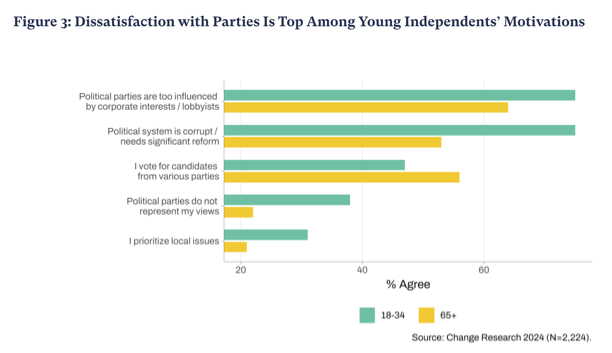
We don’t think it makes for a truly representative democracy to require an ideological declaration to be allowed to vote. In recent years, many people have left their party because they feel disgust for the direction their former party has taken. To require them to cross the spectrum and declare for another party is a big ask. Why should they have to?
Want to get involved?
Join our list of people who want to help bring Ranked Choice Voting and nonpartisan elections to Rochester and to NY in general. Click here.